Category: Planetary Physics & Geodynamics
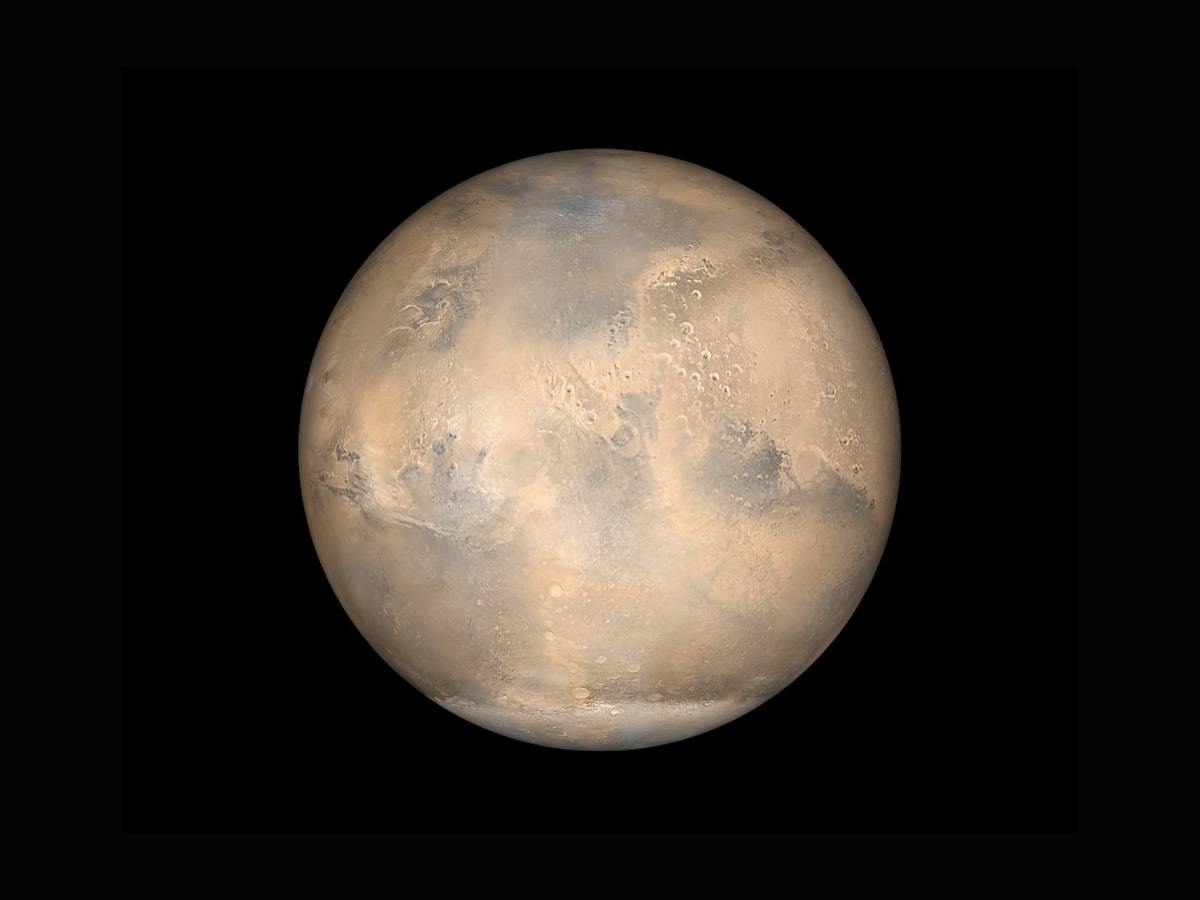
Four billion years ago, Mars was a dynamic terrestrial world possessing a global magnetic field, extensive volcanic activity, and standing surface water. Today, Mars is a hyper-arid, frozen desert enveloped in a tenuous carbon dioxide atmosphere (< 1% Earth's surface pressure), lacking a global dipole field. In contrast, Earth has sustained an active magnetosphere for over 3.5 to 4.0 billion years. Comparing the divergent evolutionary trajectories of the geodynamo and the Martian dynamo reveals the critical thermodynamic controls governing planetary habitability.
1. The Extinction of the Martian Dynamo (~4.1–3.9 Ga)
Remanent magnetization measured in ancient Martian crustal terranes (Noachian crust and the Allan Hills 84001 meteorite) proves that Mars generated an intense magnetic dipole field in its early history. However, giant impact basins such as Hellas, Argyre, and Isidis (~3.9–4.1 Ga) are completely unmagnetized, confirming that the Martian dynamo shut down catastrophically early in planetary history.
Core Volume and Planetary Scaling
Mars possesses approximately one-tenth the mass of Earth and a smaller iron-rich core (radius ~1,830 km). Because planetary volume scales with the cube of the radius ($V \propto R^3$) while surface area scales with the square ($A \propto R^2$), the surface-area-to-volume ratio ($A/V \propto 1/R$) is significantly higher for Mars than Earth. Mars radiated its primordial accretionary heat into space far more rapidly than Earth.
2. Mantle Convective Modes: Plate Tectonics vs. Stagnant Lid
A dynamo cannot operate in isolation: core heat must be continuously evacuated across the core-mantle boundary by the overlying silicate mantle. The efficiency of mantle heat extraction is dictated by the planetary convective regime:
Earth: Mobile Lid (Plate Tectonics)
Earth operates in a mobile-lid plate tectonic regime. Subducting cold oceanic lithospheric slabs plunge all the way to the core-mantle boundary, maintaining an efficient heat sink that cools the base of the mantle and extracts 10 to 15 TW of heat from the core. This massive heat flux sustains vigorous core convection and inner core crystallization.
Mars: Stagnant Lid Regime
Mars operates in a stagnant-lid regime: a thick, immobile lithospheric shell encloses the entire convective mantle. In a stagnant-lid planet, heat can only escape the mantle by slow conduction through the thick lid. As the Martian mantle struggled to evacuate heat, the temperature contrast across the core-mantle boundary collapsed. Without a sufficient temperature gradient to drive thermal convection, core overturn ceased.
3. Atmospheric Sputtering and Non-Thermal Stripping
The extinction of the Martian dynamo had immediate, catastrophic consequences for atmospheric retention. Without a global magnetic field to stand off the supersonic solar wind (a stream of magnetised protons and alpha particles moving at 400–800 km/s), the solar wind impacted the Martian upper atmosphere directly.
Sputtering and Ion Pick-up Mechanics
Data from the NASA MAVEN mission demonstrate that solar wind electric fields accelerate atmospheric ions (O₂⁺, CO₂⁺), stripping them into interplanetary space via ion pick-up and kinetic sputtering. Over billions of years, this process stripped away several bars of atmospheric pressure and drove the photochemical dissociation and loss of Mars’ surface water inventory.
The Planetary Scale Metric
Martian Dynamo Lifespan: ~ 500 million years (Died ~ 4.0 Ga) | Earth Dynamo Age: > 3.5–4.0 Ga (Active) | Modern Martian Atmospheric Escape Rate: ~ 100 grams/second
| Planetary Parameter | Earth | Mars | Geophysical Impact |
|---|---|---|---|
| Mantle Tectonic Mode | Mobile Lid (Plate Tectonics) | Stagnant Lid | Earth subduction extracts core heat; Mars insulated core |
| Core State | Solid inner core + Liquid outer core | Fully liquid (sulfur-rich, InSight data) | Mars lacks compositional inner-core crystallization engine |
| Surface Magnetic Dipole | 30,000–60,000 nT | 0 nT (Localized crustal patches only) | Mars atmosphere directly exposed to solar wind stripping |
4. Key Takeaways and Geophysical Summary
- Early Martian Dynamo: Ancient crustal remanence confirms Mars possessed a vigorous dynamo until ~4.1–3.9 Ga, when it extinguished abruptly.
- Stagnant Lid Insulation: Mars’ immobile lithosphere failed to evacuate core heat efficiently, collapsing the core-mantle temperature gradient required for thermal convection.
- Absence of Inner Core Engine: Modern InSight seismic data show Mars’ core is fully liquid and sulfur-rich, indicating it never activated an inner-core compositional engine.
- Atmospheric Stripping: Loss of magnetic deflection permitted unhindered solar wind sputtering, depleting Mars’ atmosphere and desiccating its surface.